






















On average, the entire financing process can take 4 to 8 weeks. However, you can get pre-qualified for your mortgage in less than 48 hours so you can view properties knowing what your ideal or maximum mortgage amount should be. Sometimes private and developer financing can close quicker.
Working with an experienced agent and lender familiar with cross-border transactions helps streamline the process.
Our local team in Costa Rica connects you with trusted local and international lenders, helps you prepare required documentation, and guides you through every legal and financial step — ensuring transparency, security, and peace of mind from offer to closing.
No restrictions apply to foreign ownership. However, additional costs such as legal fees, property valuation, and transfer taxes apply to all buyers. Your real estate agent at The Agency Costa Rica can help estimate total closing costs so you can plan accurately, including the financing costs to buy property in Costa Rica.
Down payments typically range from 20% to 50% depending on the lender and borrower profile.
Interest rates are usually between 7% and 11%, varying based on term length, currency, and the borrower’s residency status. Fixed-rate options are increasingly available through international lender programs with The Agency Costa Rica partners.
The main financing options to buy property in Costa Rica include:
- Local bank mortgages in Costa Rica (usually in colones or U.S. dollars).
- Private or developer financing, offering faster approvals and flexible terms.
- U.S.-style mortgage programs for US citizens through selected lenders, ideal for buyers earning in USD.
- Home-equity loans or financing from your home country secured against another property.
Yes. Foreign buyers enjoy the same ownership rights as locals and can access both local and international financing options. While traditional Costa Rican banks may require more documentation and higher down payments, several private lenders and international mortgage programs are designed for foreign investors. US-style mortgage options are available for US citizens and permanent residents.
When selling a luxury home in Costa Rica, it’s important to understand how capital gains tax works. A capital gain occurs when you sell an asset for more than you paid for it. In Costa Rica, most capital gains are taxed at 15%, including those from real estate transactions.
The capital gains tax in Costa Rica applies to the sale of houses, apartments, land, offices, and other types of real estate, as long as the property isn’t your main residence. Capital gains tax is a percentage amount so it is proportionally equal regardless of actual value.
Capital gains tax occurs when the property is transferred, either through a direct sale of the actual title of the land or home, or an indirect sale such as through the transfer of shares of the company (corporation, LLC, etc) that owns the property.
When purchasing beachfront property in Costa Rica, thorough due diligence is crucial to ensure a smooth transaction and avoid future complications. Here are the essential steps and considerations:
- Consult with your LX agent
- Hire a specialized lawyer
- Title search
- Survey check
- Zoning and environmental regulations check
- Professional inspections
- Legal action if necessary
- Due diligence period
- Costs and deposits
The short answer if there is an MLS in Costa Rica is both: yes and no. Yes, there are multiple listing systems operating in Costa Rica, but unfortunately no, there is no MLS that is comprehensive even to a modest degree. Unlike the United States or Canada, where an MLS provides comprehensive and reliable data on property listings, Costa Rica operates differently.
Technically speaking, it is not possible to sell a concession property in Costa Rica because the property remains under government ownership. Consequently, it cannot be purchased either. However, it is possible to obtain the concession rights and utilize the property within the limits established by the municipality.
Yes, foreigners have the option to own beach property in Costa Rica, either under their individual personal names with their passport, or through a corporation. When it comes to regular property purchases in Costa Rica foreigners face minimal requirements, usually only needing a valid visa for Costa Rica.
In Costa Rica, when we use the term “condominio,” we’re not talking about the high-rise apartment complexes you might associate with the term “condo” or “condominium” abroad. Instead, think of a “condominio” as a gated residential community. Picture an enclosed neighborhood or a community of homes with shared common areas and shared services such as security.
Legally, a condominium in Costa Rica is a type of real estate where individual units (or individual homes) within a larger property are owned privately, while common areas and facilities are shared among the unit owners.
In Costa Rica, a concession property is land owned by the government but managed by a private individual or company. Concession properties are mostly found along the coast, making up about 95% of beachfront land. Both Costa Ricans and foreigners can invest in concession property in Costa Rica, which helps the economy grow.
Yes, the child of a foreigner can attend public school in Costa Rica. However, keep in mind there are both benefits and drawbacks to both the public and private school system in Costa Rica. While public schooling is a universal right for Costa Rican residents, many international families prefer to explore private education options for their children.
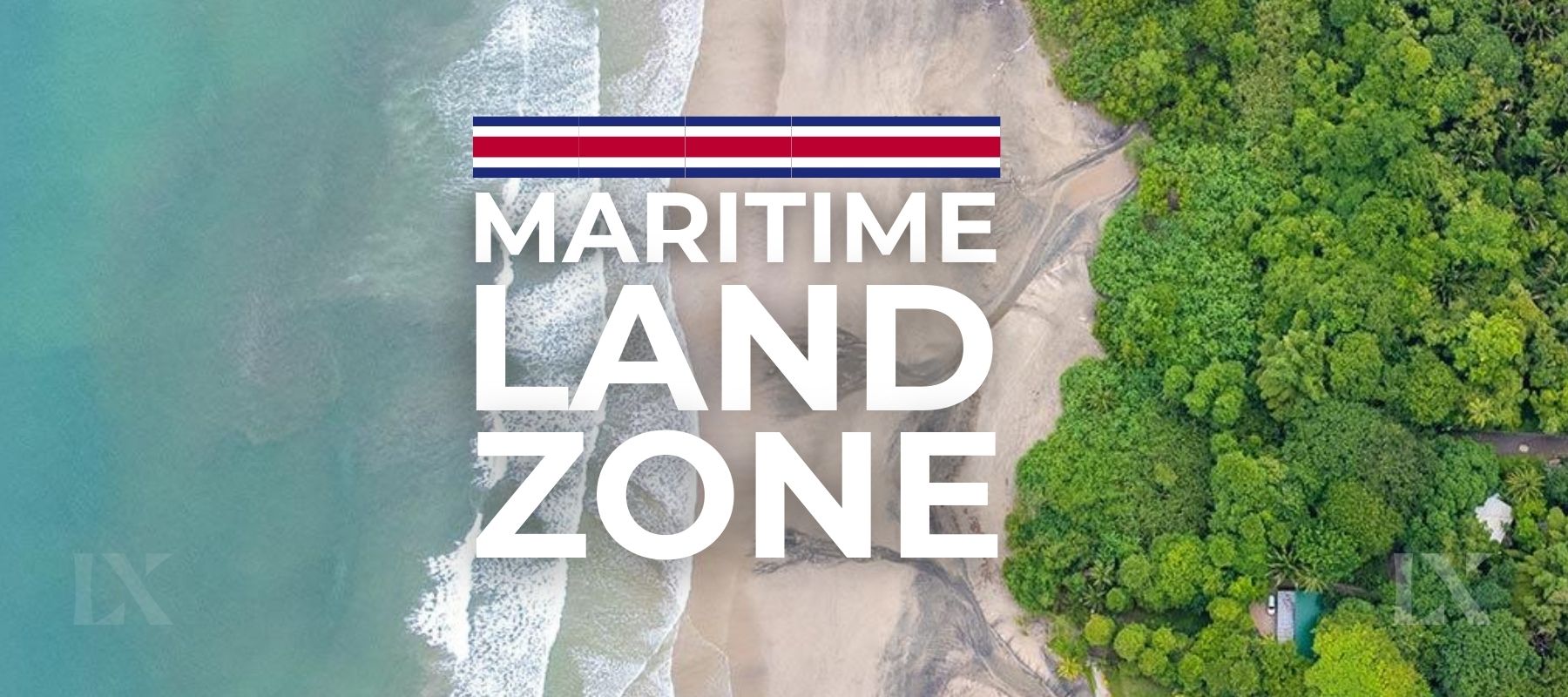
In Costa Rica, the area where the sea meets the land is known as the maritime land zone, ZMT, and it’s controlled by laws that define this boundary calculated inland from the average high tide. The maritime land zone is considered national territory owned by the State of Costa Rica, meaning it can’t be sold or owned privately over time.
However, it is possible to lease some of this land under a Costa Rica concession agreement, and in very rare cases there are private titled beachfront properties that do not fall under the maritime land zone law. The main law that governs this maritime zone is called “Ley de la Zona Marítima Terrestre” or Law 6043.
Fee simple refers to the most complete form of property ownership under the law. It’s a term primarily used in common law jurisdictions, including the United States, Canada, and parts of the Commonwealth.
In Costa Rica, the legal system does not use the term “fee simple.” However, the concept of titled property in Costa Rica implies full, direct ownership of property with the rights to transfer or encumber the property, analogous to the term fee simple ownership used in other countries.
Rent-to-own or rent-to-buy in Costa Rica doesn’t adhere to a single standard model so it requires special attention. Due to its subjective nature, a lease option contract in Costa Rica can be more or less flexible and highly dependent on the initial negotiation parameters as established by both the seller and tenant/buyer. The main considerations to discuss are pricing, down payment, purchase term and rental recognition when the home is finally purchased.
One key aspect that sets the home rental scene in Costa Rica apart is the absence of a standardized renting contract. Unlike generic templates, each agreement in Costa Rica is a customized arrangement tailored to the needs and preferences of both the property owner and the prospective tenant.
In this context, the real estate agent assumes a crucial role, serving as an intermediary to facilitate negotiations and ensure a harmonious agreement often including multiple lawyers as well as the homeowner and renter.
The right agent will ensure your needs and preferences properly match the renter, area, property, and the ideal terms for the rental agreement.
While it’s possible to own the property at a personal level, even as a foreigner, often the best option of legal structure for property ownership in Costa Rica involves using a Costa Rican corporation, LLC, or similar.
There are costs associated with owning or buying a luxury property in Costa Rica. These include taxes, transfer fees, legal fees, property taxes, capital gains tax, and the luxury property tax.
The cost of buying a luxury property in Costa Rica typically amounts to a percentage of the transactional value. On average, this ranges between 3% and 3.5% over the transactional value, including taxes and registry stamps. Legal fees range between 1 and 1.25% according to established rates.
The legal process of buying a home in Costa Rica involves the following steps:
- Sales Purchase Agreement
- Legal Due Diligence
- Title Structure
- Closing
The most significant legal difference is that Costa Rica has a centralized property system, guarded by the national registry. This institution regulates that any transfer of title must formally take place before a public notary.
Know your client is the documentation process through which the banking, financial, and real estate sectors in Costa Rica reduce uncertainty risk that the person with whom you are doing business is not engaged in illegal activities.
The first question to ask is who is really going to do the job, and be involved in the design process and execution of the project.
Number two is the level of experience in construction and the level of involvement in the construction process of the architectural firm.
The final question is regarding their expertise in BIM and their experience implementing it. BIM or Building Information Modeling is the key and main tool for today’s architectural practices.
Real estate transaction costs can be paid equally by the two parties; however, like other parts of the transaction, the actual payment (not the amount) is subject to negotiation between the parties and can be covered by the buyer, the seller, or in equal or varying proportions between the two sides.
The legal responsibility for paying the costs and applicable fees, either to the governmental authorities or to the attorneys participating in the transaction, must be covered by each party involved.
The starting cost for legal fees in Costa Rica real estate transactions are:
Legal fees =
1.25% of the total cost of the transaction for the transfer of the property
+
0.65% of the total cost of the transaction for the elaboration of legal documents for the transaction
A lawyer in Costa Rica will always be in charge of legal advice for the parties. The lawyer can be an attorney at law and he can be an attorney at fact, representing the party’s interest in a company or specific business.
On the other hand, a public notary, instead of being a specialist in law, this person has been authorized by the state to record the agreements between the parties and their will to enter a specific business.
An attorney for a real estate transaction is not required if the transaction is an indirect one, by transferring the stocks, but it is highly advised to have one.
The National Registry of Costa Rica is a public office in charge of safeguarding a public database holding the owners of movable and immovable assets in the country, safekeeping their interests and rights.
Yes, foreign ownership of properties is very common in Costa Rica. Any foreign citizen can validly own real estate in Costa Rica. They will have the same rights and obligations as any Costa Rican citizen.
The main tools to know in architectural services are several, but, the very first tool you need to know about today’s architectural services is also the most important one: BIM. BIM stands for Building Information Modelling.
The architectural design process takes the following steps:
- Conversation with the clients about the needs and desires of the project
- Three-dimensional model of virtual reality images.
- Refining and perfecting.
- Preparation and production of construction plans
- Request for building permits, approvals and others.
- Construction begins.
The current trends in windows are matte black and smoky gray in both glass and aluminum colors. There is also a change in the lacquer style that was brighter, to a more contemporary one.
The window warranties in Costa Rica normally span a year. Gaviota grants a guarantee of even 5 years because they focus on mitigation.
The window opening system refers to the ways in which the customer wants his window to move.
Important changes have taken place in the world of window frames. For example, less aluminum is being used. Windows are being made with crosscuts, with wider and less noticeable cutting. There are constant improvements in both glass safety and efficiency, as well as opening systems.
When looking for window providers, it is important to rely on both the architect and the person in charge of the actual window supply and installation.
The short answer if there is an MLS in Costa Rica is both: yes and no. Yes, there are several multiple listing systems in Costa Rica, but unfortunately no, there is no MLS that is comprehensive even to a modest degree.
→ Read more about MLS in Costa Rica
Costa Rica’s healthcare system is among the best in Latin America, featuring a mix of public and private options, particularly concentrated in the Central Valley. It offers affordable care—costing a fraction of U.S. prices—with many English-speaking doctors trained internationally. Private healthcare facilities are continually upgraded, enhancing quality and accessibility.
To integrate into the local community after moving to Costa Rica, clients should embrace the “Pura Vida” lifestyle, learn basic Spanish, and delve into the local customs and traditions. Joining expat communities, participating in local events, and enjoying the cuisine can also help them connect with both locals and fellow foreigners. Adapting to the relaxed work culture and understanding traditional greetings will enhance their experience, which is sometimes the hardest transition to make.
The biggest challenges for expats moving to Costa Rica include the language barrier (despite a lot of spoken English), adjusting to cultural differences, and differences in infrastructure. Despite these challenges, many find the slower pace of life, focus on sustainable living, and access to stunning landscapes offer a healthier, more fulfilling lifestyle worth the differences in their home country.
Post-COVID-19, the market has seen a robust recovery, attracting international investors with its resilient economy and increased demand for luxury homes, particularly in less urbanized, scenic areas. With a 20% increase in construction activities and a surge in permits for homes over 200 square meters over the past year, Costa Rica will likely continue to be a magnet for foreign investors.
Offering significant value, properties here boast luxurious amenities at a fraction of US and Western European costs, with expectations for continued growth into 2024 driven by economic expansion in picturesque beach towns and more secluded locations. The government here also makes it very easy for foreign ownership of property giving the same rights as local citizens.
Costa Rica is renowned for its stable democracy and has thrived without an army for over 75 years, promoting social and economic stability. While it’s generally safe, clients should still consider implementing standard safety and security measures on their property. Some clients prefer to live in a luxury apartment or gated community with 24-hour security on-site for ultimate peace of mind.
- Our 100% Costa Rica native team has built deep local knowledge and connections throughout decades of working with local experts that help clients with property management, interior design, legal and financial advice, and more.
.
You can sign up for property updates within the LX network.
We have an extensive asset library full of resources that help you easily start the conversation with your client about buying a home in Costa Rica. This includes videos, images, text, links and other marketing and sales materials that will support you in engaging your client.
Yes. You can represent your client for the buying side of the transaction as long as you accompany your client or representative during calls, visits, and negotiation. The LX team will help you during each step as we represent the seller side and guide you for everything you need in Costa Rica. Standard buyer-side commission is 50% of the total commission, which typically ranges between 5-6%.
There are a few ways you can work with LX and receive a commission.
- Make a referral through email or phone by contacting an LX agent.
- Bring your client down to Costa Rica.
- Come down to Costa Rica on behalf of your client.
Buyers should be aware of the property transfer tax, annual property taxes, and luxury home tax. Additionally, understanding municipal fees and capital gains tax for selling property is important.
Costa Rica’s Maritime Zone Law states that the first 200 meters of beachfront land from the high-tide line is public, with the first 50 meters completely public and the next 150 meters available for lease under restricted conditions.
Yes, it’s highly recommended to have an attorney for real estate transactions in Costa Rica. An attorney will ensure that all binding paperwork is in order, the seller has provided all necessary information for the sale, the property registry is updated and that all legal requirements are met for a secure transaction.
Key legal considerations include ensuring the property has a clear title, verifying zoning and land use regulations, and understanding municipal regulations. It’s also crucial to confirm no liens or encumbrances affect the property.
No, a residency visa is not required to purchase property in Costa Rica. Foreigners can buy and own property with the same rights as Costa Rican citizens. However, you can become eligible for the resident investor visa. By purchasing real estate in Costa Rica, you’ll be able to apply for legal residency that will allow you similar residency rights as Costa Rican citizens.
In Costa Rica, property ownership rights are generally strong for both locals and foreigners. Unlike some countries, foreigners enjoy the same ownership rights as citizens, but all transactions must be registered in the national registry.
Whether your client should rent a luxury home before buying depends on their preferences and comfort with relocating. LX agents can facilitate tours of premium rentals, allowing your client to experience living in Costa Rica firsthand before making a purchase decision.
We are ready to help when you are. The first step is to share your preferences regarding location, amenities, and property type with your LX agent. Whether you desire a community condo or a secluded estate, we then refine the search to showcase homes that align with your vision.
Expats have settled in areas that include the Central Valley for its cool climate and amenities, the Pacific Coast towns like Tamarindo and Jacó for their beaches and vibrant communities, and the Nicoya Peninsula, known for its laid-back lifestyle and natural beauty.
The best way to learn about the real estate market in Costa Rica is by working with established local agents who possess deep insights and experience. LX agents, known for their extensive local knowledge, are invaluable resources for navigating the market effectively.
Yes, we offer virtual tours allowing agents to guide clients through properties remotely, perfect for international buyers looking to explore luxury homes in Costa Rica from afar.
Costa Rica offers a diverse range of luxury properties including estates, standalone homes, gated community residences, apartments, multi-family homes, fincas (farm properties), land lots, and commercial or industrial properties.
- Referral commission ranges depending on the involvement of the referring agent. This lands between 20-30%
- Total transaction commission is between 5-8%
- Set up a video call for a live virtual presentation. The Agency Costa Rica team will teach you about the luxury real estate market here, understand what areas and property types are best for your client, show you the full buying and legal process, meet our 100% Costa Rican team with deep local roots, and extend your knowledge base into one of the best places to invest in the tropics.
- Receive access to our learning hub resources that help you start the conversation with your client about buying a home in Costa Rica. This includes videos, images, text, links and other marketing and sales materials that will support you.
- Bring your client to Costa Rica for a tour of homes, or come for a visit on their behalf.
- Simply refer your client by email or phone. We’ll keep you informed throughout the entire purchase process.
Rent-to-own in Costa Rica offers a unique path to homeownership through a period of renting that precedes the purchase. This approach lacks a uniform structure, making each agreement distinct and heavily reliant on the initial terms negotiated between the seller and the prospective buyer. Flexibility and specifics of a rent-to-own contract in Costa Rica can greatly vary, influenced by an array of factors determined during the negotiation phase. For a deeper dive into how rent-to-own works in Costa Rica, including insights into navigating its complexities,